 Another ōlelo no’eau Okay, so I've been listening to Mark Keali'i Ho'omalu's CD "Call It What You Like" in the car lately driving around Lawrence and it's definitely got me in a Hawaiian mood. As any of you who've followed my blog know, I occasionally try to find tidbits of wisdom, proverbs, or stories from the languages I'm studying. (Notice I don't use the past tense "studied." I mean, do we ever really finish "studying" a language, whether it's a new foreign language or our own mother tongue? I think learning a language is a lifelong process and a lifelong endeavor. I point that out to my students of Spanish who think they'll "study" Spanish for one or two semesters and then they'll know it and be done with it. That just makes me want to quote Nelson on the Simpsons and say, "Ha ha!") Anyhow, Hawaiian. Here is the latest ōlelo no’eau ("important saying" or proverb) from Hawai'i:Maka'ala ke kanaka kahea manu.alert DEF man call birdA man who calls birds should always be alert.The ancient Hawaiian ali'i, chiefs, wore capes and headdresses crafted by weaving in thousands of tiny bird feathers. The Kanaka Kahea Manu, bird-caller, would imitate bird calls to attract birds to him. When they approached, he would pluck out a small number of their feathers and let the birds go. Once he called the birds, he had to stay alert and be prepared to move quickly to catch them when they came near. This proverb advises one who wishes to succeed to be alert to opportunities and seize them when they arise.By the way, that definite article ke reminds me of something. Do any ōlelo Hawai'i kine out there know the answer to this question? It appears other Polynesian languages have only one form of the definite article, such as Tahitian and Māori te. Hawaiian, however, has two: ke and ka. I know ke is used most often before nouns beginning with a vowel or the letter k (e.g., ke ala, ke kanaka) and ka is used before nouns beginning with all other consonants, including glottal stops (e.g., ka hula, ka 'aina). But why do a few words beginning with p (e.g., pā, dish and po'o, head) require ke instead of ka before them? So far I've found no good answers in the dictionaries or grammar books I have. Has this phenomenon even been studied? (Aw, it must have been!) Ā hui hou.
"...Early Hawaiian monumental architecture was comparable to ... the Maya or the early Egyptians...since all appeared to have linked temple construction to economic, political and ritual development." Maui's Oldest T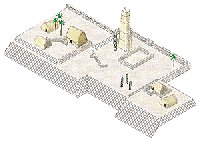 emple, Pi'ilanihale Heiau, named for its famous Chief Pi'ilani, has now been dated to 1214 and is 400 years older than previously thought. It measures larger than a football field and stands 12 meters in height.Archaeologica (link at right) has an interesting article from Discovery News on this temple and what it reveals about the Polynesian past. Here are some highlights of the article:
"The most elaborate temples featured altars, oracle towers, offering pits, palisades, drum houses, and god or ancestral images carved from wood or stone."
"At some events there would have been human sacrifice, the killing of hundreds of pigs, the sounds of music and drumming, and the smell of burning fires."
"Members of the chiefly class were allowed into sacred areas of the temples, but they had to get in prostrate positions or lie down, sometimes for hours, as a sign of submission and respect for the chief."
Interesting stuff! By the way, James Michener's Hawai'i is quite well researched and offers a fascinating description of early Hawaiian (and Polynesian) culture and life right on up to the "colonizing" by Christian missionaries and the overthrow of the Hawaiian monarchy by US businessmen, descendants of these missionaries.Question: Does anyone know where the name Hawai'i comes from?
More on RumsenOkay, now back to some serious linguistic stuff. I think this post will be mostly my thinking out loud to try and get a better handle on Rumsen Ohlone and Utian in general.Utian languages seem to operate on the basis of root, stem, and theme. At least in Ohlone, the root usually, although perhaps not always, corresponds to the noun form. The stem often changes from the root form by various means, usually either through metathesis, ablaut, or vowel length alternation. (This more or less corresponds to Marc Okrand's [1974] assessment of Mutsun, a close cousin of Rumsen.) For example:
comb - n. xaxxews, v. xaxwen (past tense, to comb) - stem = xaxw (?)
wolf - n. *'um(u)x, v. 'umxun (to hunt wolves) - stem = 'umux (?)
mtn. lion - n. *xeek(e)s, v. xeksen (to hunt lions) - stem = xeks (?)* Note that, unlike in Mutsun, the final vowel (of nouns, at least) is either whispered or completely dropped in Rumsen.It seems that, in preparing a dictionary, the various forms of the stem must be shown or at least cross-referenced in order to help the learner in assembling the various verb forms, giving examples as appropriate. Perhaps something like:wolf, n. 'umx (v. 'umxun).
wolves, to hunt, v. 'umxun (n. 'umx). Ex. 'Iče mak'umxun. Let’s hunt wolves. 'Uyk wa’umxunin. Yesterday he went wolf-hunting.Is this making some sort of sense?
Another interesting thing about Rumsien is its lack of an actual genitive form, with possessor and possessed simply placed in juxtaposition with each other:
Ka ‘ukx tip.
my friend knife
My friend’s knife.Apparently, if one wanted to say "my friend the knife" (as sadistic as that sounds!), one would say:Ka ‘ukx sa tip.
my friend DEF knife
My friend the knife.
Castration Frustration
OK, so I guess this is what happens when one really doesn't have anything specific in mind for a post but one wants to keep up the blog. Well, this is related to anthropology, after all, which in turn is related to linguistics. So....
I was reading a post on Archaeologica (see link at right) about the Italian exhumation of a popular opera castrato. Of course curiosity got the best of me and I had to read up more on castrati and castratism. I had no idea there was such a market for this back into the 1500s, and the practice continued in Italy until the 1800s.
Here is a Wikipedia article:
http://en.wikipedia.org/wiki/Castrato
I was particularly amused, and also saddened somehow, both at the same time, when I read this line from the Wikipedia article:
Castration was by no means a guarantee of a promising career. During the 16th, 17th and 18th centuries, only approximately 1% of fully or partially castrated boys developed into successful singers.
That must have really sucked! I mean to be neutered for what turned out to be no good reason...that must have been frustrating!
All in the name of entertainment.
Ancient Hawaiian ChantI came across this oli ho'ohanohano ali'i or chant for revering the chief. It is not for dancing. The chanters were probably accompanied only by the sound of a single drum. It gives a sense of the reverence paid to the ancient (god-like) chiefs:Nō ka lani ka moku, ka honua,
Ka uka, ka moana, nō ka lani,
Nona ka pō, nona ke ao,
A nona ke kau, ka ho’oilo, ka makali’i,
Ka malama, ka huihui hōkū lani e kau nei.Here is my attempt at a translation:For the Chief the island, the earth,
The mountains, the sea, for the Chief,
For him the darkness, for him the light,
And for him the seasons, the winter, the summer,
The moon, the clustered stars placed in the heavens.Chant from Spoken Hawaiian by Samuel Elbert, 1970. The translation is mine.
A mixed bag
I’ve had a lot of thoughts about what to write here, but none of them have really congealed into anything that I felt like expanding into a whole post. So, I decided to just put down a few things that may or may not be of interest to the outside world. (Judging by the number of comments to this blog so far, I suspect there are only a select few of us who find this blog even remotely interesting!)
Anyway, here’s the mixed bag du jour:
Malformed Spanish place names:
I always find it interesting that many Spanish place names around the Bay Area and California in general are ill-formed, often ungrammatical, indicating perhaps that there was no consultation with a native Spanish speaker before they were named. Perhaps one of the most famous of these is the restaurant/fruit stand called Casa de Fruta near Hollister. Now, in Spanish, a definite article (in this case la) is required after the preposition de, of, in order to indicate that “fruit” can be bought here. As named, the real translation is “house built of fruit,” which probably isn’t what they had in mind and doesn’t make much sense. I always enjoyed another sign I often passed in Monterey over the door of a veterinary hospital: Casa de Amigos. Now, I’m sure they had no ill intent in naming this veterinary clinic, but, again, this should be Casa de Los Amigos indicating that it’s a house where friends congregate. As named, it really means “house made out of friends (body parts?),” not quite the impression they wanted to convey, I’m sure!
Ohlone Abalone
According to Merriam Webster, the word “abalone” originally comes into English from Spanish abulón, which was originally borrowed from the Rumsen Ohlone awlon. So, here’s a Rumsen sentence using the word:
Ačista exxe root awlonakay.
Monterey-LOC much be abalone-PL
There is much abalone in Monterey.
I’m not sure what the actual Rumsen name for Monterey, Ačis, means. (I wish I did!)
If you’re unsure what abalone is, here’s the Merriam Webster Online definition:
any of a genus (Haliotis) of edible rock-clinging gastropod mollusks that have a flattened shell slightly spiral in form, lined with mother-of-pearl, and with a row of apertures along its outer edge
A hui hou!
Rumsen MetathesisRecently, on Jabal Al-Lughat, Lameen posted an example of metathesis from Sierra Miwok, a language rather closely related to the Ohlone languages. I thought it would be nice to show some Rumsen Ohlone examples of metathesis:'itčen tar '
itčnen become stuck in tar
čumay aspen
čumyan look for aspens (?)
meekel salamander
meeklen hunt salamanders
'umux wolf '
umxun hunt wolves
These examples reflect second syllable metathesis (as in Sierra Miwok) between verbal forms and noun forms.